
Tips for Passing the MBLEx Exam: A Practical Study Guide
November 25, 2026 | Massage Therapy | Share this Post:Completing massage therapy school is an important achievement, but there’s another step between finishing your training and becoming a licensed massage therapist: passing the Massage & Bodywork Licensing Examination (MBLEx).
The MBLEx tests your understanding of the knowledge needed to practice massage therapy safely and professionally. For students preparing to become licensed massage therapists in Ohio, passing this exam is a required part of the licensing process.
While taking a licensing exam can feel intimidating, good preparation can make a difference. Whether you’re still attending massage therapy school or getting ready for your test date, these MBLEx study tips can help you organize your preparation, strengthen your knowledge, and approach exam day with greater confidence.
Understand What to Expect on the MBLEx
Before you begin studying, it helps to understand how the exam works.
The MBLEx is administered by the Federation of State Massage Therapy Boards (FSMTB). It consists of 100 multiple-choice questions, and candidates have 110 minutes to complete the exam.
The exam uses computer-adaptive testing, meaning the difficulty of questions adjusts based on your responses. You must answer questions in the order presented and complete all 100 questions within the allotted time.
According to the FSMTB, the exam covers seven major subject areas:
- Anatomy and Physiology (11%): Body systems, their structures, and how they function.
- Kinesiology (12%): Muscles, joints, movement, and range of motion.
- Pathology, Contraindications, Areas of Caution, and Special Populations (14%): Health conditions and situations that may affect massage treatment.
- Benefits and Effects of Soft Tissue Manipulation (15%): Massage techniques and their physiological and psychological effects.
- Client Assessment, Reassessment, and Treatment Planning (17%): Evaluating client needs and determining appropriate approaches to treatment.
- Ethics, Boundaries, Laws, and Regulations (16%): Professional responsibilities, scope of practice, and ethical conduct.
- Guidelines for Professional Practice (15%): Safety, sanitation, documentation, business practices, and professional standards.

Understanding these categories helps you focus your preparation on the material that matters.
1. Create a Realistic MBLEx Study Schedule
One of the most effective ways to prepare for the MBLEx is to study consistently rather than trying to review everything shortly before the exam.
Start by determining how much time you have until your test date. Then divide the material into manageable sections.
For example, a four-week study plan might look like this:
- Week 1: Review anatomy, physiology, kinesiology, and muscle functions.
- Week 2: Focus on pathology, contraindications, and the effects of massage techniques.
- Week 3: Study client assessment, ethics, professional boundaries, and business practices.
- Week 4: Complete practice exams, review challenging subjects, and reinforce your knowledge.
Try setting aside 30 to 60 minutes each day for focused studying. Adjust your schedule based on your existing knowledge and the amount of time you need.
Short, consistent sessions can make it easier to retain information and avoid feeling overwhelmed.
2. Use Active Learning Instead of Just Reading
Reading textbooks and reviewing class notes are useful, but reading the same material repeatedly isn’t always the best way to remember it.
Active learning requires you to recall information and demonstrate your understanding.

Some practical techniques include:
- Flashcards: Create cards for anatomical terminology, muscle actions, contraindications, and other important concepts.
- Practice questions: Answer questions without consulting your notes, then review the explanations.
- Teach someone else: Explain a concept aloud as though you’re teaching another massage therapy student.
- Anatomy diagrams: Label muscles, bones, and body systems from memory.
- Spaced repetition: Return to challenging concepts over several days instead of reviewing them only once.
For example, rather than simply memorizing the names of muscles, practice identifying their locations, actions, and relationships to movement.
The goal isn’t just to recognize the correct answer. It’s to understand why it’s correct.
3. Focus on Applying Your Knowledge
The MBLEx evaluates knowledge relevant to real massage therapy practice. That means preparation should go beyond memorizing definitions.
Think about how the material applies to situations you might encounter when working with clients.
For example, consider a client who arrives for a massage and mentions a recent injury.
What additional information should you gather? Are there contraindications to consider? Would you need to modify the treatment or refer the client to another healthcare professional?
Questions like these encourage you to connect different areas of your training.
As you study, practice thinking through client scenarios involving:
- Health history and client assessments
- Conditions requiring treatment modifications
- Informed consent and professional boundaries
- Proper sanitation and safety procedures
- Appropriate massage techniques and treatment planning
Developing this type of clinical reasoning can help you make informed decisions when answering exam questions.
4. Don’t Overlook Ethics and Professional Practice
It’s easy to concentrate heavily on anatomy and massage techniques because they’re such visible parts of massage therapy training.
However, ethics, professional boundaries, client assessment, and professional practice account for a substantial portion of the MBLEx.
These subjects are also essential to providing safe, responsible care.
Make sure you understand concepts such as informed consent, client confidentiality, appropriate draping, scope of practice, and professional communication.
Pay particular attention to situations involving ethical decisions.
For example, what should a massage therapist do when a client requests a service outside the therapist’s scope of practice?
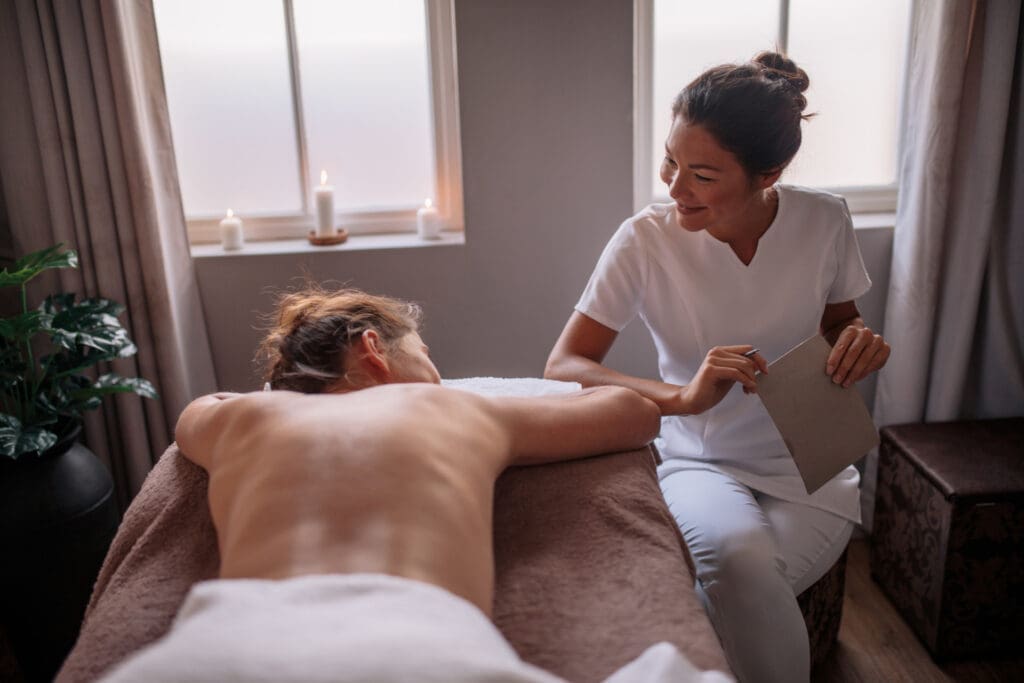
Understanding professional responsibilities can help you recognize appropriate responses rather than relying on memorized answers.
5. Take MBLEx Practice Exams and Review Your Mistakes
Practice exams are valuable because they help you become familiar with answering multiple-choice questions while identifying areas where you may need more preparation.
The FSMTB offers official study resources, including the Official MBLEx Study Guide and MBLEx Check, an online readiness assessment designed to simulate the exam experience.
These resources can be found through the FSMTB MBLEx Study Tools page.
When taking practice tests, pay attention to more than your overall score.
Review the questions you missed and ask yourself:
- Did I misunderstand the question?
- Was I unfamiliar with the subject?
- Did I confuse two similar concepts?
- Did I overlook important details in the wording?
Keep a list of topics that need additional review.
Remember that practice tests are learning tools, not guarantees of how you’ll perform on the actual exam.
6. Practice Managing Your Time
With 100 questions to complete in 110 minutes, time management is an important part of taking the MBLEx.
You have slightly more than one minute per question on average.
During practice sessions, work on reading questions carefully without spending too much time on any single answer.

A few strategies include:
- Read the entire question before reviewing the answer choices.
- Look for important qualifiers, such as best, most appropriate, or contraindicated.
- Eliminate answers that are clearly incorrect.
- Choose the answer best supported by your knowledge.
- Avoid second-guessing yourself solely because a question seems difficult.
Since the exam is computer-adaptive, you must answer each question in sequence rather than skipping questions and returning later.
Practicing under timed conditions can help you become more comfortable with the pace.
7. Make Use of Your Massage Therapy Training
Your massage therapy education is one of your most important resources when preparing for the MBLEx.
At Schools of Medical Massage (SOMM), students study anatomy and physiology, massage theory and techniques, pathology, ethics, and professional practices. The curriculum also includes MBLEx review as students progress through their training.
Hands-on learning and clinical experience provide opportunities to connect classroom knowledge with practical situations.
When reviewing material, think about what you learned during your clinical training. Consider how you evaluated client needs, maintained professional boundaries, applied proper techniques, and followed safety procedures.
If you’re struggling with a subject, ask your instructors for clarification or suggestions for additional review.
Taking advantage of the knowledge and experience available during massage therapy school can help strengthen your preparation.
8. Prepare for Exam Day Ahead of Time
Even with thorough preparation, arriving at the testing center feeling rushed or uncertain can make the experience more stressful.
A few days before your appointment, review the FSMTB’s MBLEx examination requirements and confirm the details of your test.
Make sure you:
- Know the location of your Pearson VUE testing center.
- Have the required identification, with information that matches your examination registration.
- Understand the testing center’s rules regarding personal belongings.
- Plan to arrive at least 30 minutes before your appointment.
- Get adequate sleep the night before your exam.
On exam day, give yourself enough time to travel, check in, and settle into the testing environment.

Remember that you don’t need to know everything about massage therapy to succeed. You’re being evaluated on the knowledge expected of an entry-level professional.
What Happens After You Pass the MBLEx?
Once you’ve passed the MBLEx, you’re one step closer to becoming a licensed massage therapist.
In Ohio, passing the examination is part of the licensure process administered by the State Medical Board of Ohio. Candidates must also meet the state’s educational, application, and other licensing requirements.
Passing the MBLEx does not automatically grant you a massage therapy license. You must receive the appropriate state license before practicing professionally.
You can also read our post “What Happens After You Graduate Massage Therapy School?” to learn more about what to expect.
Build Confidence Through Preparation
Preparing for the MBLEx takes time, but you don’t have to approach it all at once.
Start with a realistic study schedule, concentrate on understanding the material, and use practice exams to identify where you need improvement. Most importantly, remember that the knowledge you’re reviewing is intended to help you become a safe, capable massage therapy professional.
At Schools of Medical Massage, our goal is to help students develop the knowledge, practical skills, and professional understanding needed to pursue massage therapy licensure.
With campuses in Cincinnati, Cleveland, Columbus, Dayton, and Lima, SOMM offers hands-on massage therapy training that combines classroom education with clinical experience.
Learn more about our Massage Therapy Program and explore your next step toward a career in massage therapy.